Set 1 of 3
Light and Atomic Models
Waves, photons, emission spectra and the Bohr model.
[Price]See what's inside
High School Chemistry · Chapter 3 · Set 3 of 3
Atomic radius, ionic radius, ionization energy, electronegativity and metallic character: which way each one goes, and the one-line reason why.
90 practice questions, 3 quizzes and a full unit test, with every answer worked out step by step.
Notes, revision sheets, exam traps, flashcards and lab skills in one place. Stop searching. Start studying.
Honors parts are clearly marked. No need to buy twice.
| Free preview | Full set [Price] | |
|---|---|---|
| Sample pages from every file | ✓ | ✓ all 228 pages |
| Complete notes for every lesson | – | ✓ |
| 90 practice questions with worked answers | a few | ✓ |
| 3 quizzes and a full unit test | – | ✓ |
| 40 flashcards and lab skills | – | ✓ |
Right after checkout you get a download page and an email with all 7 PDFs. They're yours to keep.
Yes, for Regular and Honors high school chemistry. Honors-only parts are clearly marked, so Regular students can skip them.
Yes. They're normal PDFs, made to print on letter-size paper. The flashcards print double-sided.
Tap any cover at the top to see sample pages, or download the free preview first.
Instant download · 7 PDFs · Regular + Honors
★ HONORS topics are for Honors classes. Regular students can skip them.
Free stuff
13 pages from the real set. No sign-up. Free to share as is.
Read the free sample below ↓Or tap any cover at the top of this page to flip through sample pages from all 7 files.
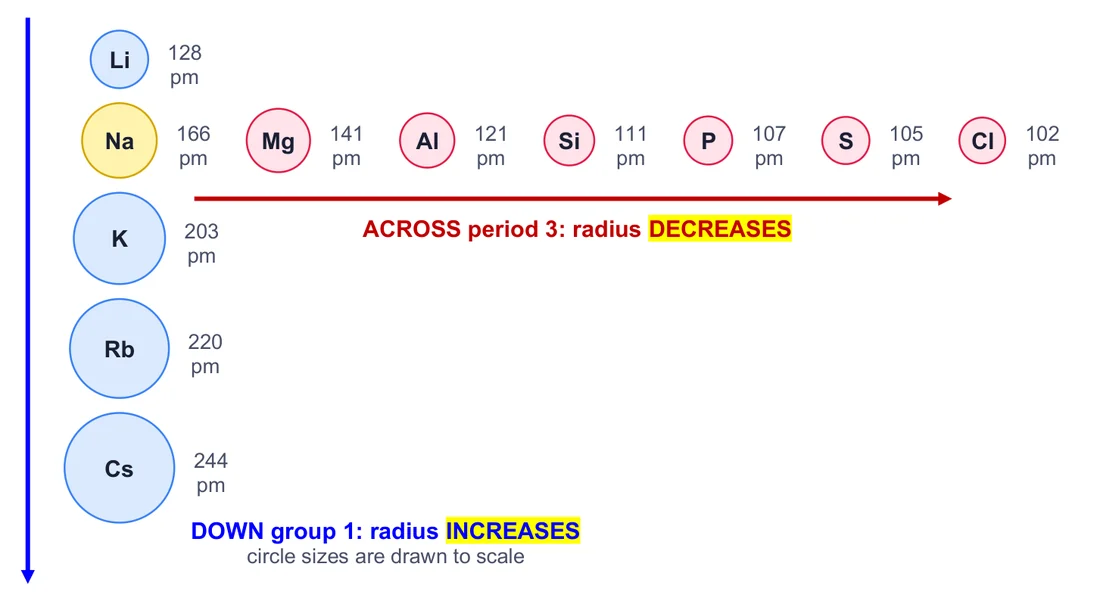
Rank potassium (K), magnesium (Mg) and sulfur (S) from the largest atom to the smallest.
Step 1. Find each element on the table. K: period 4, group 1. Mg: period 3, group 2. S: period 3, group 16.
Step 2. Compare the two in the same period. Mg and S are both in period 3. S is farther right, so it has more protons pulling on the same energy level. S is smaller than Mg.
Step 3. Bring in the third element. K is one period lower than Mg (one more energy level) and also farther left. Both rules say K is larger. K is larger than Mg.
Answer: K > Mg > S. Real values: K 203 pm, Mg 141 pm, S 105 pm.
EXAM TRAP 11 | Explaining with “more electrons”
✗ WHAT STUDENTS WRITE: “Chlorine has more electrons than aluminum, so chlorine is the larger atom.”
✓ WHAT EARNS THE POINTS: Chlorine is smaller (102 pm vs 121 pm). It has more protons, and its extra electrons go into the same energy level, so the stronger nucleus pulls that level in closer.
Why it’s wrong: Across a period the extra electrons do not add a new level. The extra protons are what change the pull.
MEMORY TRICK Across: more protons, same level.
EXAM TRAP 17 | Ranking ions by the size of their atoms
✗ WHAT STUDENTS WRITE: “A sodium atom is bigger than a chlorine atom, so Na+ is bigger than Cl−.”
✓ WHAT EARNS THE POINTS: Count first. Na+ has lost its outer level (10 electrons); Cl− has gained one (18 electrons). Cl− is larger (167 pm vs 116 pm).
Why it’s wrong: Forming ions shrinks the metal and swells the nonmetal, so the order of the atoms can flip.
MEMORY TRICK Ions? Count electrons first.
EXAM TRAP 23 | Linking a high IE to a reactive metal
✗ WHAT STUDENTS WRITE: “Cesium is very reactive because it has a high ionization energy.”
✓ WHAT EARNS THE POINTS: Cesium is reactive because its ionization energy is low (376 kJ/mol). Its outer electron comes off easily.
Why it’s wrong: Metals react by losing electrons, so the easier the electron leaves, the more reactive the metal.
MEMORY TRICK Low IE, lively metal.
More like this in the free Periodic Table and Trends preview. The full set has the rest of the notes, revision sheets, exam traps and practice with worked answers.
Atomic radius gets smaller from left to right across a period, because more protons pull the same energy levels in closer. It gets larger down a group, because each row adds an energy level.
Ionization energy increases across a period and decreases down a group, the opposite of atomic radius. Smaller atoms hold their outer electrons more tightly.
It's how strongly an atom attracts shared electrons in a bond. It increases across a period and decreases down a group, and fluorine has the highest value.
A group is a vertical column; main-group elements in the same group have the same number of valence electrons and similar properties. A period is a horizontal row of elements with the same number of occupied energy levels.
Losing electrons often empties the outer energy level, and the remaining electrons are pulled in by the same number of protons. An anion is larger, because the added electrons push each other apart.
Set 1 of 3
Waves, photons, emission spectra and the Bohr model.
Set 2 of 3
Orbitals, filling rules, noble-gas shortcuts and orbital diagrams.