Set 2 of 3
Electron Configurations
Orbitals, filling rules, noble-gas shortcuts and orbital diagrams.
[Price]See what's inside
High School Chemistry · Chapter 3 · Set 1 of 3
Wavelength, frequency and photon energy, the c = λν and E = hν math, and how bright-line spectra led to the Bohr and quantum models.
98 practice questions, 3 quizzes and a full unit test, with every answer worked out step by step.
Notes, revision sheets, exam traps, flashcards and lab skills in one place. Stop searching. Start studying.
Honors parts are clearly marked. No need to buy twice.
| Free preview | Full set [Price] | |
|---|---|---|
| Sample pages from every file | ✓ | ✓ all 215 pages |
| Complete notes for every lesson | – | ✓ |
| 98 practice questions with worked answers | a few | ✓ |
| 3 quizzes and a full unit test | – | ✓ |
| 32 flashcards and lab skills | – | ✓ |
Right after checkout you get a download page and an email with all 7 PDFs. They're yours to keep.
Yes, for Regular and Honors high school chemistry. Honors-only parts are clearly marked, so Regular students can skip them.
Yes. They're normal PDFs, made to print on letter-size paper. The flashcards print double-sided.
Tap any cover at the top to see sample pages, or download the free preview first.
Instant download · 7 PDFs · Regular + Honors
★ HONORS topics are for Honors classes. Regular students can skip them.
Free stuff
13 pages from the real set. No sign-up. Free to share as is.
Read the free sample below ↓Or tap any cover at the top of this page to flip through sample pages from all 7 files.
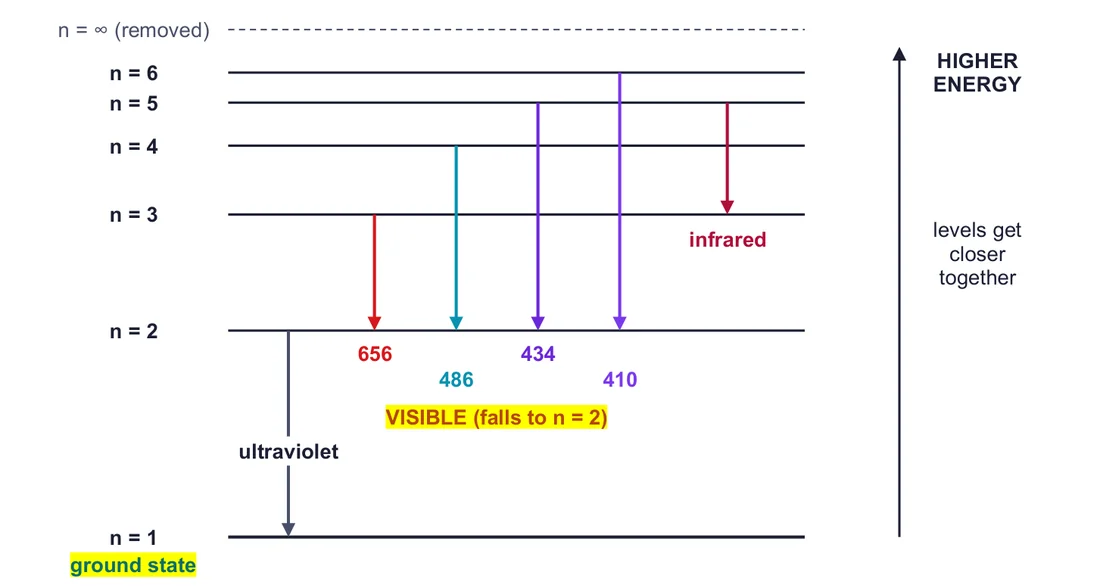
Which photon has the shorter wavelength: one from a 4 → 2 fall or one from a 3 → 2 fall?
Think: the 4 → 2 fall is bigger (it crosses more of the ladder), so the photon has more energy. More energy means higher frequency and shorter wavelength.
Answer: the 4 → 2 photon (486 nm) is shorter than the 3 → 2 photon (656 nm).
EXAM TRAP 13 | Forgetting to change nm to m
✗ WHAT STUDENTS WRITE: “For 535 nm light: ν = 3.00 × 10⁸ / 535 = 5.61 × 10⁵ Hz.”
✓ WHAT EARNS THE POINTS: 535 nm = 5.35 × 10⁻⁷ m. Then ν = 3.00 × 10⁸ m/s / 5.35 × 10⁻⁷ m = 5.61 × 10¹⁴ Hz.
Why it’s wrong: c is in meters per second, so λ must be in meters too. An answer near 105 Hz is a radio frequency, not green light.
MEMORY TRICK Meters in, hertz out.
EXAM TRAP 9 | Brighter light means more energetic photons
✗ WHAT STUDENTS WRITE: “A brighter red lamp gives off red photons with more energy than a dim red lamp.”
✓ WHAT EARNS THE POINTS: Both lamps give off red photons with the same energy. The bright lamp gives off more photons each second.
Why it’s wrong: The color fixes the energy of each photon (E = hν). Brightness only changes how many photons there are.
MEMORY TRICK Color = energy each. Brightness = how many.
EXAM TRAP 24 | Orbit and orbital mean the same thing
✗ WHAT STUDENTS WRITE: “An orbital is the circular path an electron travels around the nucleus.”
✓ WHAT EARNS THE POINTS: An orbit (Bohr) is an exact path. An orbital (quantum model) is a region where the electron is likely to be found, about 90% of the time.
Why it’s wrong: The words differ by three letters, so they get swapped. Tests reward the word region or probability.
MEMORY TRICK An orbit is a track; an orbital is a cloud.
More like this in the free Light and Atomic Models preview. The full set has the rest of the notes, revision sheets, exam traps and practice with worked answers.
Use c = λν, so ν = c ÷ λ, with c = 3.00 × 10⁸ m/s and the wavelength in meters. Light at 500 nm (5.00 × 10⁻⁷ m) has a frequency of 6.00 × 10¹⁴ Hz.
Use E = hν, where h = 6.626 × 10⁻³⁴ J·s, or E = hc ÷ λ. Higher frequency and shorter wavelength mean more energy.
Electrons absorb energy and jump to higher energy levels. When they fall back, they give off photons whose energy equals the gap between the levels. Each element has its own levels, so each has its own line spectrum.
Electrons move around the nucleus in fixed energy levels and change levels only by absorbing or emitting an exact amount of energy. It explains hydrogen's spectrum but not atoms with many electrons, so it was replaced by the quantum mechanical model.
From lowest to highest energy: radio, microwave, infrared, visible, ultraviolet, X-rays and gamma rays. In visible light, red has the lowest energy and violet the highest.
Set 2 of 3
Orbitals, filling rules, noble-gas shortcuts and orbital diagrams.
Set 3 of 3
How the table is built and the five trends, with real element data.