Set 1 of 3
Light and Atomic Models
Waves, photons, emission spectra and the Bohr model.
[Price]See what's inside
High School Chemistry · Chapter 3 · Set 2 of 3
Write the configuration of almost any element or ion with confidence: aufbau, Pauli and Hund's rule, noble-gas shorthand and orbital diagrams.
110 practice questions, 4 quizzes and a full unit test, with every answer worked out step by step.
Notes, revision sheets, exam traps, flashcards and lab skills in one place. Stop searching. Start studying.
Honors parts are clearly marked. No need to buy twice.
| Free preview | Full set [Price] | |
|---|---|---|
| Sample pages from every file | ✓ | ✓ all 213 pages |
| Complete notes for every lesson | – | ✓ |
| 110 practice questions with worked answers | a few | ✓ |
| 4 quizzes and a full unit test | – | ✓ |
| 32 flashcards and lab skills | – | ✓ |
Right after checkout you get a download page and an email with all 7 PDFs. They're yours to keep.
Yes, for Regular and Honors high school chemistry. Honors-only parts are clearly marked, so Regular students can skip them.
Yes. They're normal PDFs, made to print on letter-size paper. The flashcards print double-sided.
Tap any cover at the top to see sample pages, or download the free preview first.
Instant download · 7 PDFs · Regular + Honors
★ HONORS topics are for Honors classes. Regular students can skip them.
Free stuff
12 pages from the real set. No sign-up. Free to share as is.
Read the free sample below ↓Or tap any cover at the top of this page to flip through sample pages from all 7 files.
Configuration: 1s2 2s2 2p3 (7 electrons)
1s: ↑↓ 2s: ↑↓ 2p: ↑ ↑ ↑
The three 2p electrons go one per box with the same spin (Hund’s rule). Nitrogen has 3 unpaired electrons.
EXAM TRAP 7 | Filling 3d before 4s
✗ WHAT STUDENTS WRITE: “After 3p comes 3d, because all of level 3 fills before level 4. Titanium is [Ar] 3d4.”
✓ WHAT EARNS THE POINTS: 4s is lower in energy than 3d, so it fills first: 3p → 4s → 3d → 4p. Titanium is [Ar] 4s2 3d2.
Why it’s wrong: From n = 3 on, the levels overlap. The filling order follows energy, not the level number.
MEMORY TRICK The d block runs one row behind: row 4 fills 3d.
EXAM TRAP 19 | Adding electrons to make a cation
✗ WHAT STUDENTS WRITE: “Potassium gains one electron to become K+: [Ar] 4s2.”
✓ WHAT EARNS THE POINTS: A + charge means electrons were lost. Potassium (19) loses its 4s electron, so K+ has 18 electrons: 1s2 2s2 2p6 3s2 3p6, the same as [Ar].
Why it’s wrong: Electrons are negative, so taking them away leaves the particle positive. Students who read “plus” as “add” get every cation backwards.
MEMORY TRICK Plus = lost. Minus = gained.
EXAM TRAP 23 | Counting d electrons as valence electrons
✗ WHAT STUDENTS WRITE: “Gallium has 13 valence electrons: 4s2 3d10 4p1.”
✓ WHAT EARNS THE POINTS: Valence electrons are in the highest level only. For gallium that is n = 4: 4s2 4p1 = 3 valence electrons. The 3d10 is in level 3, so it is core.
Why it’s wrong: 3d is written between 4s and 4p, so it looks like part of the outer level. Check the level number, not the position in the line.
MEMORY TRICK Main groups: valence = last digit of the group number.
More like this in the free Electron Configurations preview. The full set has the rest of the notes, revision sheets, exam traps and practice with worked answers.
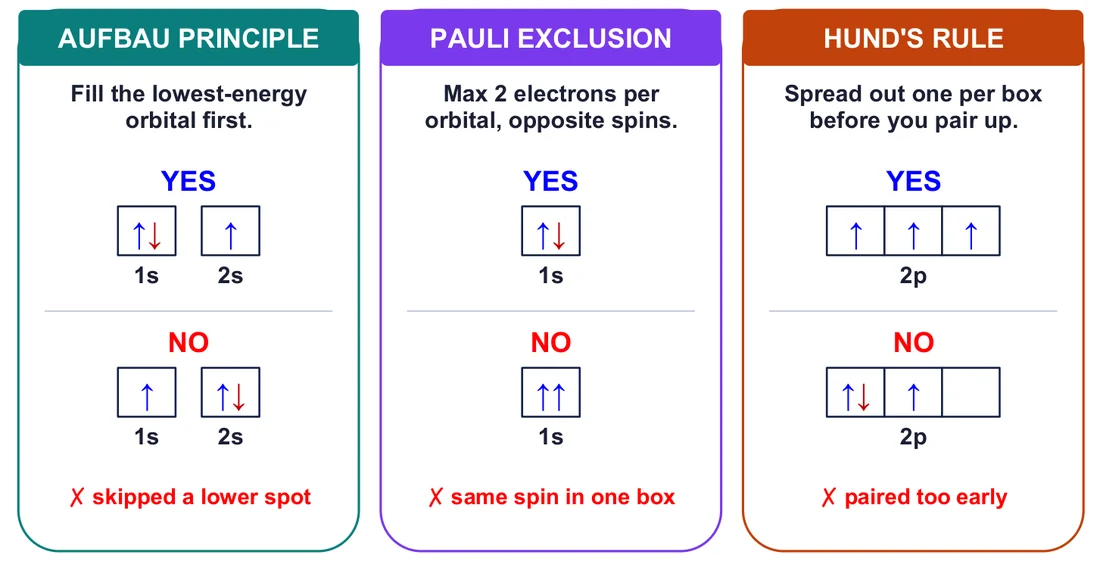
Fill sublevels from lowest to highest energy: 1s, 2s, 2p, 3s, 3p, 4s, 3d, 4p, 5s and so on. An s sublevel holds 2 electrons, p holds 6, d holds 10 and f holds 14. Oxygen is 1s² 2s² 2p⁴.
In orbitals of equal energy, electrons go in one at a time with the same spin before any of them pair up. That's why each of nitrogen's three 2p orbitals has one electron.
An orbital holds at most two electrons, and those two must have opposite spins.
Write the symbol of the noble gas before the element in brackets, then add the electrons after it. Sodium is [Ne] 3s¹.
Add electrons for a negative ion and remove them for a positive ion. For transition metals, remove the 4s electrons before the 3d ones, so Fe²⁺ is [Ar] 3d⁶.
Set 1 of 3
Waves, photons, emission spectra and the Bohr model.
Set 3 of 3
How the table is built and the five trends, with real element data.