Set 1 of 3
Atomic Theory
From Democritus to the nuclear atom, one experiment at a time.
[Price]See what's inside
High School Chemistry · Chapter 2 · Set 3 of 3
Why chlorine's mass is 35.45 and not 35 or 37. Isotope notation, weighted averages and the calculator steps that get them right.
90 practice questions, 3 quizzes and a full unit test, with every answer worked out step by step.
Notes, revision sheets, exam traps, flashcards and lab skills in one place. Stop searching. Start studying.
Honors parts are clearly marked. No need to buy twice.
| Free preview | Full set [Price] | |
|---|---|---|
| Sample pages from every file | ✓ | ✓ all 170 pages |
| Complete notes for every lesson | – | ✓ |
| 90 practice questions with worked answers | a few | ✓ |
| 3 quizzes and a full unit test | – | ✓ |
| 24 flashcards and lab skills | – | ✓ |
Right after checkout you get a download page and an email with all 7 PDFs. They're yours to keep.
Yes, for Regular and Honors high school chemistry. Honors-only parts are clearly marked, so Regular students can skip them.
Yes. They're normal PDFs, made to print on letter-size paper. The flashcards print double-sided.
Tap any cover at the top to see sample pages, or download the free preview first.
Instant download · 7 PDFs · Regular + Honors
★ HONORS topics are for Honors classes. Regular students can skip them.
Free stuff
11 pages from the real set. No sign-up. Free to share as is.
Read the free sample below ↓Or tap any cover at the top of this page to flip through sample pages from all 7 files.
Read. Lithium (Z = 3) has two natural isotopes. Lithium-6 has a mass of 6.0151 amu and makes up 7.59% of lithium atoms. Lithium-7 has a mass of 7.0160 amu and makes up 92.41%.
Step 1. Estimate. Almost all lithium is Li-7, so the answer should be just under 7.0 amu.
Step 2. Change each percent to a decimal. 7.59% = 0.0759 and 92.41% = 0.9241.
Step 3. Multiply each mass by its decimal, then add. (6.0151 × 0.0759) + (7.0160 × 0.9241) = 0.4565 + 6.4835 = 6.94 amu
Step 4. Check. 6.94 amu is between 6.0151 and 7.0160, and much closer to 7.0160. It matches the estimate.
Answer: 6.94 amu
EXAM TRAP
“Just add the two masses and divide by 2.”
Average atomic mass is a weighted average. Multiply each mass by its decimal abundance, then add; the answer must sit closer to the more common isotope.
EXAM TRAP
Writing oxygen-18 with 18 on the bottom.
The mass number goes on top and the atomic number on the bottom. A can never be smaller than Z, so the bigger number is always on top.
EXAM TRAP
“Silicon-29 has 29 protons.”
The number after the hyphen is the mass number. Silicon (Z = 14) has 14 protons, so silicon-29 has 29 − 14 = 15 neutrons.
More like this in the free Isotopes and Atomic Mass preview. The full set has the rest of the notes, revision sheets, exam traps and practice with worked answers.
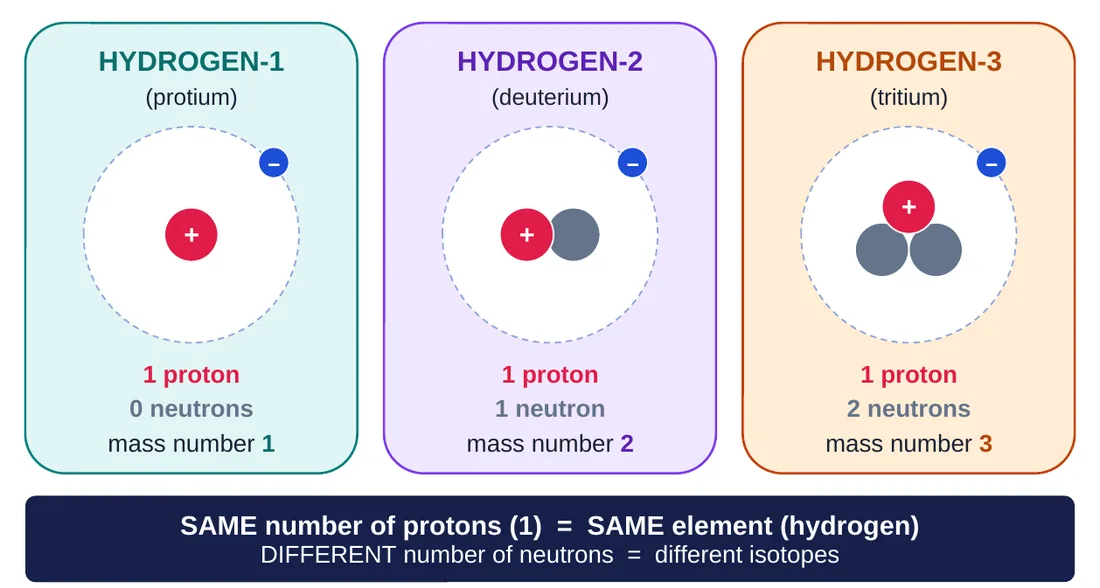
Isotopes are atoms of the same element with the same number of protons but a different number of neutrons, so they have different mass numbers. Carbon-12 and carbon-14 are isotopes of carbon.
Multiply the mass of each isotope by its abundance written as a decimal, then add the results. For chlorine: 34.969 × 0.7576 + 36.966 × 0.2424 = 35.45 amu.
It's a weighted average of all the element's naturally occurring isotopes, each with its own mass and abundance.
Write the element name or symbol with its mass number, like carbon-14 or C-14. In a nuclear symbol, the mass number goes at the top left and the atomic number at the bottom left.
Almost exactly. They have the same number of protons and electrons, so their chemistry is the same. They differ in mass, and some are radioactive.
Set 1 of 3
From Democritus to the nuclear atom, one experiment at a time.
Set 2 of 3
Protons, neutrons, electrons, ions and nuclear symbols.