Set 1 of 3
Atomic Theory
From Democritus to the nuclear atom, one experiment at a time.
[Price]See what's inside
High School Chemistry · Chapter 2 · Set 2 of 3
Count the particles in any atom or ion, read and write nuclear symbols, and never mix up atomic number and mass number again.
93 practice questions, 3 quizzes and a full unit test, with every answer worked out step by step.
Notes, revision sheets, exam traps, flashcards and lab skills in one place. Stop searching. Start studying.
Honors parts are clearly marked. No need to buy twice.
| Free preview | Full set [Price] | |
|---|---|---|
| Sample pages from every file | ✓ | ✓ all 177 pages |
| Complete notes for every lesson | – | ✓ |
| 93 practice questions with worked answers | a few | ✓ |
| 3 quizzes and a full unit test | – | ✓ |
| 30 flashcards and lab skills | – | ✓ |
Right after checkout you get a download page and an email with all 7 PDFs. They're yours to keep.
Yes, for Regular and Honors high school chemistry. Honors-only parts are clearly marked, so Regular students can skip them.
Yes. They're normal PDFs, made to print on letter-size paper. The flashcards print double-sided.
Tap any cover at the top to see sample pages, or download the free preview first.
Instant download · 7 PDFs · Regular + Honors
★ HONORS topics are for Honors classes. Regular students can skip them.
Free stuff
9 pages from the real set. No sign-up. Free to share as is.
Read the free sample below ↓Or tap any cover at the top of this page to flip through sample pages from all 7 files.
Step 1. Protons. The bottom number is the atomic number: 26 protons.
Step 2. Neutrons. Mass number minus atomic number: 56 − 26 = 30 neutrons.
Step 3. Charge? None written, so it is neutral: electrons = 26.
Answer: 26 protons, 30 neutrons, 26 electrons
EXAM TRAP
“Mg lost 2 electrons, so it is Mg2−.”
Electrons are negative. Losing two leaves the atom more positive, so the ion is Mg2+: 12 protons and 10 electrons.
EXAM TRAP
“Add protons, neutrons and electrons to get the mass number.”
The mass number counts only the nucleus: protons + neutrons. Electrons are left out.
EXAM TRAP
“The neutron is the negative particle.”
The neutron has no charge. The only negative particle in an atom is the electron.
EXAM TRAP
Using the electrons to find the element.
Only protons decide the element. A particle with 26 protons is iron whether it has 26, 24 or 23 electrons.
More like this in the free Atomic Structure preview. The full set has the rest of the notes, revision sheets, exam traps and practice with worked answers.
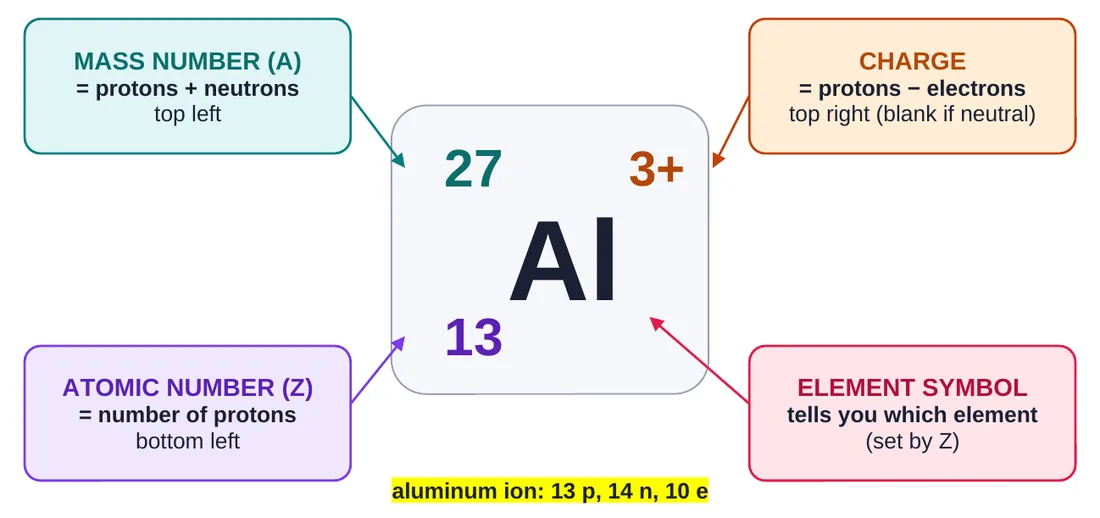
Protons equal the atomic number. Neutrons equal the mass number minus the atomic number. In a neutral atom, electrons equal protons; in an ion, subtract the charge, so a 2+ ion has 2 fewer electrons than protons.
The atomic number is the number of protons, and it tells you which element it is. The mass number is the number of protons plus neutrons in one nucleus.
A cation is a positive ion, made when an atom loses electrons. An anion is a negative ion, made when an atom gains electrons. The number of protons never changes.
The mass number is at the top left and the atomic number at the bottom left of the element symbol, with any charge at the top right. Chlorine-35 has mass number 35 and atomic number 17, so it has 17 protons and 18 neutrons.
One amu is one twelfth of the mass of a carbon-12 atom. A proton and a neutron each have a mass of about 1 amu, and an electron is about 1/1836 of that.
Set 1 of 3
From Democritus to the nuclear atom, one experiment at a time.
Set 3 of 3
Isotope notation and average atomic mass, every step shown.