Set 2 of 3
Atomic Structure
Protons, neutrons, electrons, ions and nuclear symbols.
[Price]See what's inside
High School Chemistry · Chapter 2 · Set 1 of 3
Dalton, Thomson, Rutherford: what each one did, what they saw, and how it changed the model. Exactly what tests ask you to explain.
110 practice questions, 4 quizzes and a full unit test, with every answer worked out step by step.
Notes, revision sheets, exam traps, flashcards and lab skills in one place. Stop searching. Start studying.
Honors parts are clearly marked. No need to buy twice.
| Free preview | Full set [Price] | |
|---|---|---|
| Sample pages from every file | ✓ | ✓ all 213 pages |
| Complete notes for every lesson | – | ✓ |
| 110 practice questions with worked answers | a few | ✓ |
| 4 quizzes and a full unit test | – | ✓ |
| 40 flashcards and lab skills | – | ✓ |
Right after checkout you get a download page and an email with all 7 PDFs. They're yours to keep.
Yes, for Regular and Honors high school chemistry. Honors-only parts are clearly marked, so Regular students can skip them.
Yes. They're normal PDFs, made to print on letter-size paper. The flashcards print double-sided.
Tap any cover at the top to see sample pages, or download the free preview first.
Instant download · 7 PDFs · Regular + Honors
★ HONORS topics are for Honors classes. Regular students can skip them.
Free stuff
9 pages from the real set. No sign-up. Free to share as is.
Read the free sample below ↓Or tap any cover at the top of this page to flip through sample pages from all 7 files.
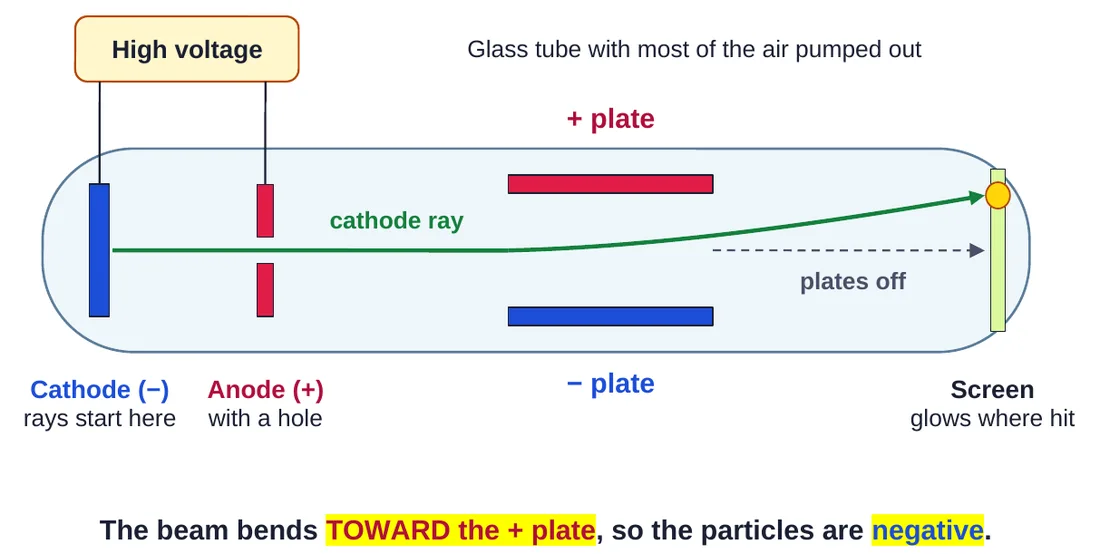
Observation 1. The beam bends toward the positive plate. Conclusion: the particles are negatively charged.
Observation 2. The beam is the same whatever metal the cathode is made of. Conclusion: these particles are in all atoms.
Answer: Atoms contain tiny negative particles, electrons, which led to Thomson’s plum pudding model.
EXAM TRAP
Drawing the beam bending toward the − plate.
Opposite charges attract. A negative beam bends toward +, not toward −.
EXAM TRAP
“Most alpha particles bounced back.”
Most went straight through the gold foil, so the atom is mostly empty space. Only about 1 in several thousand bounced back, which shows a tiny, dense, positive nucleus.
EXAM TRAP
“A neutron is negative.”
A neutron is neutral (charge 0). The negative particle is the electron, and it is outside the nucleus.
EXAM TRAP
“A reaction makes new atoms.”
A reaction makes new substances by rearranging atoms. No atom is created, destroyed or turned into another element, which is why mass is conserved.
More like this in the free Atomic Theory preview. The full set has the rest of the notes, revision sheets, exam traps and practice with worked answers.
Elements are made of tiny particles called atoms. Atoms of one element are alike and differ from atoms of other elements. Atoms combine in simple whole-number ratios to form compounds, and in a reaction atoms are rearranged, not created or destroyed.
The beam bent toward the positive plate, so it was made of negatively charged particles much smaller than an atom. Those particles are electrons, and the result led to the plum pudding model.
Most alpha particles went straight through the foil, so the atom is mostly empty space. A few bounced back sharply, so the positive charge and almost all the mass sit in a tiny, dense nucleus.
Atoms can be divided into protons, neutrons and electrons. And atoms of the same element can have different masses, which we now call isotopes.
An Honors topic. When two elements form more than one compound, the masses of one element that combine with a fixed mass of the other are in a small whole-number ratio. In CO and CO₂, the oxygen masses are in a 1:2 ratio.
Set 2 of 3
Protons, neutrons, electrons, ions and nuclear symbols.
Set 3 of 3
Isotope notation and average atomic mass, every step shown.