Set 1 of 3
Matter
Elements, compounds, mixtures, and physical vs. chemical changes.
[Price]See what's inside
High School Chemistry · Chapter 1 · Set 3 of 3
Problem solving isn't about being good at math. It's the same four steps every time: Read, Plan, Solve, Check. This set drills them until conversions feel automatic.
133 practice questions and a timed mock test, with every answer worked out step by step.
Notes, revision sheets, exam traps, flashcards and lab skills in one place. Stop searching. Start studying.
Honors parts are clearly marked. No need to buy twice.
| Free preview | Full set [Price] | |
|---|---|---|
| Sample pages from every file | ✓ | ✓ all 194 pages |
| Complete notes for every lesson | – | ✓ |
| 133 practice questions with worked answers | a few | ✓ |
| A timed mock test with a scoring guide | – | ✓ |
| 64 flashcards and lab skills | – | ✓ |
Right after checkout you get a download page and an email with all 7 PDFs. They're yours to keep.
Yes, for Regular and Honors high school chemistry. Honors-only parts are clearly marked, so Regular students can skip them.
Yes. They're normal PDFs, made to print on letter-size paper. The flashcards print double-sided.
Tap any cover at the top to see sample pages, or download the free preview first.
Instant download · 7 PDFs · Regular + Honors
★ HONORS topics are for Honors classes. Regular students can skip them.
Free stuff
32 pages from the real set. No sign-up. Free to share as is.
Read the free sample below ↓Or tap any cover at the top of this page to flip through sample pages from all 7 files.
Read. Given: a shelf 3.50 ft long. Find: its length in cm.
Plan. Road map: ft → in → cm. Factors: 12 in1 ft (exact) and 2.54 cm1 in (exact).
Solve. 3.50 ft × 12 in1 ft × 2.54 cm1 in = 106.68 cm = 107 cm
Check. A centimeter is much smaller than a foot, so the number should grow a lot: 3.50 → 107 makes sense. Both factors are exact, so 3.50 (3 significant figures) sets the answer.
Answer: 107 cm
EXAM TRAP
The factor is upside down.
45.0 cm × 2.54 cm1 in gives “114 in” and the units don’t cancel. Want over have: the unit you have goes on the bottom, so 45.0 cm × 1 in2.54 cm = 17.7 in.
EXAM TRAP
A backwards metric equality.
Writing “1 cm = 100 m” turns a 3.20 m board into 0.0320 cm. The 1 goes with the bigger unit: 1 m = 100 cm.
EXAM TRAP
Using the diameter as the radius.
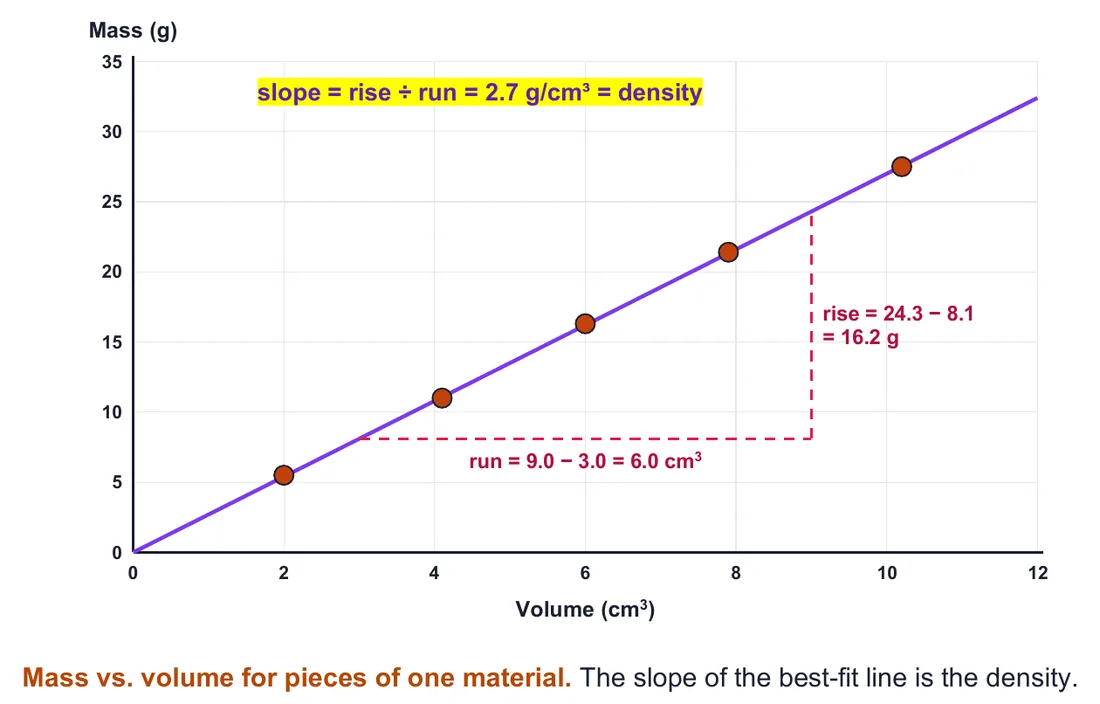
A rod 2.00 cm across has r = 1.00 cm. Skip that step and its density comes out 0.675 g/cm³, as if metal floated. Write r = d ÷ 2 on its own line first; the right answer is 2.70 g/cm³ (aluminum).
These pages come from the free Problem Solving preview. The full set has the rest of the notes, revision sheets, exam traps and practice with worked answers.
Start with the given number and its unit. Multiply by conversion factors written as fractions, with the unit you want to get rid of on the bottom. Units cancel like numbers, and when only the unit you want is left, multiply across the top and divide by the bottom.
A fraction made from an equality, like 1 in = 2.54 cm written as 2.54 cm over 1 in. The top and bottom are equal, so the fraction equals 1. It changes the unit without changing the amount.
Plan a road map from the given unit to the unit you want, for example km to m to cm. Write one conversion factor for each step in a single line, then check that every unit except the one you want cancels.
Use water displacement. Read the water level in a graduated cylinder, add the object, and read it again. The rise in the water level is the object's volume, and 1 mL = 1 cm³.
Count only the measured numbers. Exact defined values, like 100 cm in 1 m or 2.54 cm in 1 in, never limit the sig figs in your answer.
Set 1 of 3
Elements, compounds, mixtures, and physical vs. chemical changes.
Set 2 of 3
Units, scientific notation, significant figures and temperature.