Set 2 of 3
Measurement
Units, scientific notation, significant figures and temperature.
[Price]See what's inside
High School Chemistry · Chapter 1 · Set 1 of 3
Everything about how chemists sort and describe matter, from states and mixtures to the changes that make new substances, plus the energy basics tests love.
143 practice questions, 3 quizzes and a full unit test, with every answer worked out step by step.
Notes, revision sheets, exam traps, flashcards and lab skills in one place. Stop searching. Start studying.
Honors parts are clearly marked. No need to buy twice.
| Free preview | Full set [Price] | |
|---|---|---|
| Sample pages from every file | ✓ | ✓ all 235 pages |
| Complete notes for every lesson | – | ✓ |
| 143 practice questions with worked answers | a few | ✓ |
| 3 quizzes and a full unit test | – | ✓ |
| 64 flashcards and lab skills | – | ✓ |
Right after checkout you get a download page and an email with all 7 PDFs. They're yours to keep.
Yes, for Regular and Honors high school chemistry. Honors-only parts are clearly marked, so Regular students can skip them.
Yes. They're normal PDFs, made to print on letter-size paper. The flashcards print double-sided.
Tap any cover at the top to see sample pages, or download the free preview first.
Instant download · 7 PDFs · Regular + Honors
★ HONORS topics are for Honors classes. Regular students can skip them.
Free stuff
10 pages from the real set. No sign-up. Free to share as is.
Read the free sample below ↓Or tap any cover at the top of this page to flip through sample pages from all 7 files.
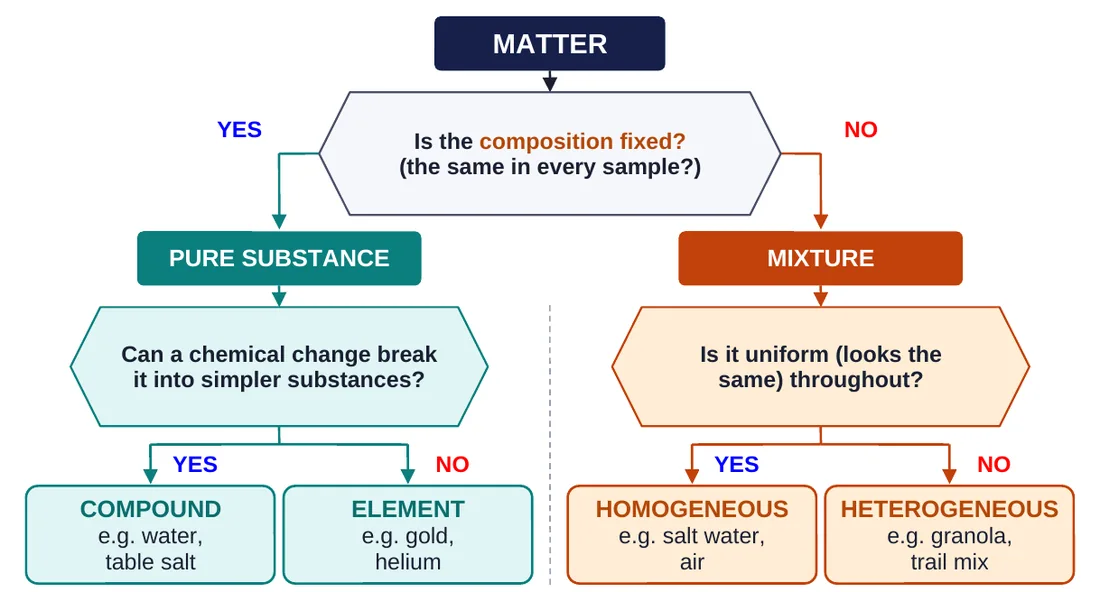
Step 1. Is the composition fixed? No. Air is mostly nitrogen and oxygen, but the amount of water vapor changes from a dry desert to a humid beach.
Step 2. So it is a mixture. Is it uniform? Yes. You cannot see separate parts, even under a microscope.
Answer: Air is a homogeneous mixture (a solution of gases), not a pure substance.
EXAM TRAP
“Sugar disappeared, so it’s a chemical change.”
Dissolving is a physical change. The sugar is still sugar; boil off the water and you get it back.
EXAM TRAP
“The log lost mass, so mass was destroyed.”
Mass is conserved. Most of the log’s mass left as gases (carbon dioxide and water vapor) that nobody weighed.
EXAM TRAP
“O2 has two atoms, so it’s a compound.”
A compound needs two or more different elements. O2 is only oxygen, so it is an element (a diatomic one).
EXAM TRAP
“It looks the same all the way through, so it’s pure.”
Uniform does not mean pure. Salt water, air and brass all look the same throughout, and all three are mixtures.
These pages come from the free Matter preview. The full set has the rest of the notes, revision sheets, exam traps and practice with worked answers.
An element has only one kind of atom and can't be broken down by a chemical reaction. A compound is two or more elements chemically bonded in a fixed ratio, like H₂O. A mixture is two or more substances combined physically, in any ratio, and it can be separated by physical means.
A homogeneous mixture looks the same all the way through, like salt water or air. A heterogeneous mixture has parts you can see, like sand in water or a salad.
Physical. The water is still H₂O, only its state changed. A chemical change makes a new substance, and the signs are gas bubbles, a color change, a precipitate, heat or light, or a new odor.
In a chemical reaction, mass is not created or destroyed. In a closed system, the total mass of the reactants equals the total mass of the products.
An intensive property doesn't depend on how much you have, like density, color or boiling point. An extensive property does, like mass and volume.
Set 2 of 3
Units, scientific notation, significant figures and temperature.
Set 3 of 3
Dimensional analysis, unit conversions and density, with one four-step method.