Set 1 of 3
Matter
Elements, compounds, mixtures, and physical vs. chemical changes.
[Price]See what's inside
High School Chemistry · Chapter 1 · Set 2 of 3
Where easy points disappear: too many sig figs, a cylinder read at the wrong spot, °F converted in the wrong order. This set closes every one of those gaps.
197 practice questions, 3 quizzes, 2 unit tests and an Honors test, with every answer worked out step by step.
Notes, revision sheets, exam traps, flashcards and lab skills in one place. Stop searching. Start studying.
Honors parts are clearly marked. No need to buy twice.
| Free preview | Full set [Price] | |
|---|---|---|
| Sample pages from every file | ✓ | ✓ all 310 pages |
| Complete notes for every lesson | – | ✓ |
| 197 practice questions with worked answers | a few | ✓ |
| 3 quizzes, 2 unit tests and an Honors test | – | ✓ |
| 90 flashcards and lab skills | – | ✓ |
Right after checkout you get a download page and an email with all 7 PDFs. They're yours to keep.
Yes, for Regular and Honors high school chemistry. Honors-only parts are clearly marked, so Regular students can skip them.
Yes. They're normal PDFs, made to print on letter-size paper. The flashcards print double-sided.
Tap any cover at the top to see sample pages, or download the free preview first.
Instant download · 7 PDFs · Regular + Honors
★ HONORS topics are for Honors classes. Regular students can skip them.
Free stuff
42 pages from the real set. No sign-up. Free to share as is.
Read the free sample below ↓Or tap any cover at the top of this page to flip through sample pages from all 7 files.
Read. (a) Room temperature is 25.0 °C. Convert it to kelvin. (b) Liquid nitrogen boils at 77 K. Convert it to °C.
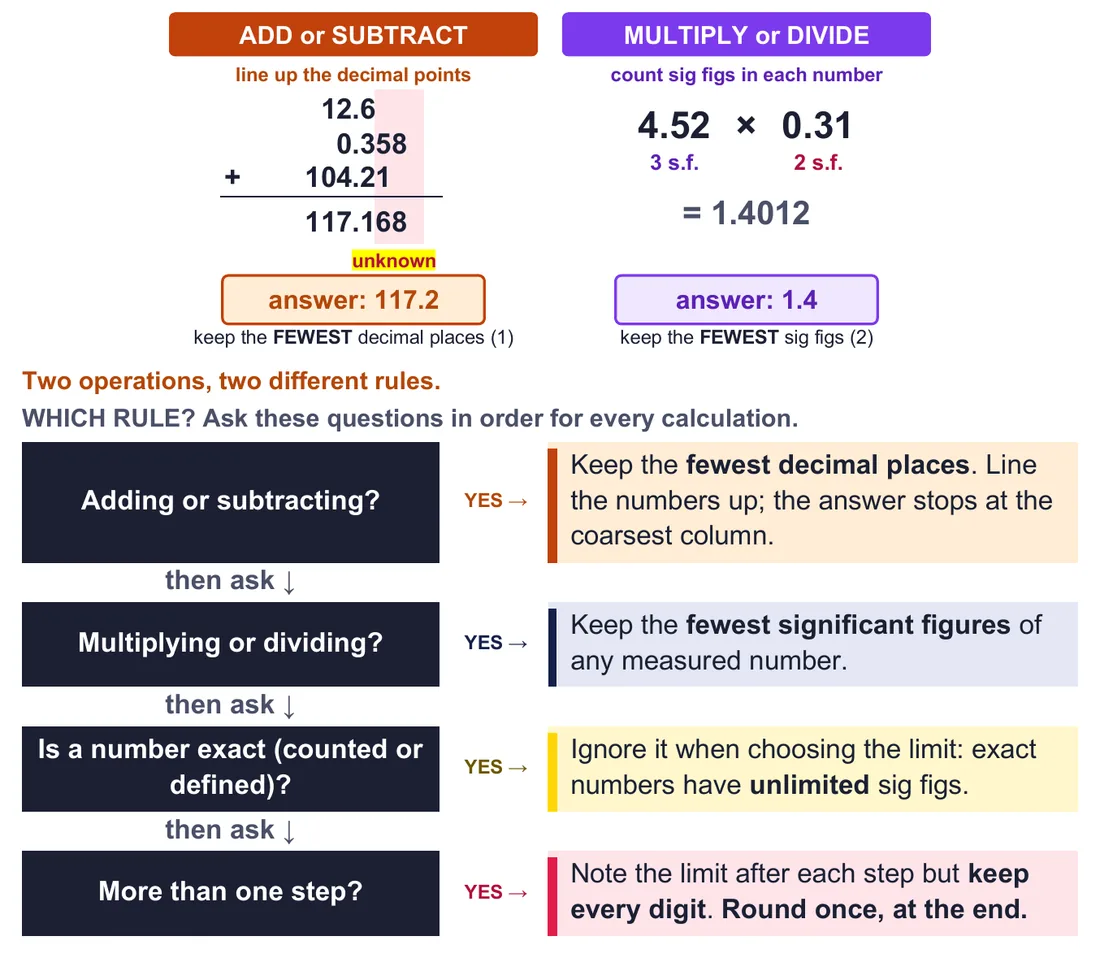
Solve (a). K = 25.0 + 273.15 = 298.15, which rounds to 298.2 K, because 25.0 has one decimal place.
Solve (b). °C = 77 − 273.15 = −196.15, which rounds to −196 °C, because 77 has no decimal places.
Check. Kelvin numbers are always 273.15 bigger than Celsius numbers, and never negative.
Answer: (a) 298.2 K (b) −196 °C
EXAM TRAP
Adding or subtracting 273.15 the wrong way.
The kelvin number is always the bigger one. To K, add 273.15; to °C, subtract it. 37.0 °C is 310.2 K, not −236.2 K.
EXAM TRAP
Reading the meniscus from the top of the curve.
Set the cylinder flat on the bench, get your eye level with the liquid, and read the bottom of the curve.
EXAM TRAP
Reading a buret upward, like a graduated cylinder.
A buret’s 0 is at the top, so count down from the labeled line above the liquid: 33.48 mL, not 33.52 mL.
EXAM TRAP
Rounding in stages.
Round once, from the original number. 2.346 to 2 significant figures is 2.3, not 2.35 and then 2.4.
These pages come from the free Measurement preview. The full set has the rest of the notes, revision sheets, exam traps and practice with worked answers.
Nonzero digits always count, and zeros between nonzero digits count. Leading zeros never count. Trailing zeros count only when the number has a decimal point, so 6.200 has 4 sig figs but 4500 has 2.
Accuracy is how close a measurement is to the true value. Precision is how close repeated measurements are to each other. A set of results can be precise without being accurate.
Add 273.15 (many classes round to 273): K = °C + 273.15. Kelvin has no negative values and is written without a degree sign.
Move the decimal point until one nonzero digit is in front of it, then multiply by 10 raised to the number of places you moved. Big numbers get a positive exponent and small numbers a negative one, so 0.00052 = 5.2 × 10⁻⁴.
The kilogram, not the gram. Other SI base units you'll use in chemistry are the meter, second, kelvin and mole.
Set 1 of 3
Elements, compounds, mixtures, and physical vs. chemical changes.
Set 3 of 3
Dimensional analysis, unit conversions and density, with one four-step method.